


This study with RED fluid dynamics aims to provide a glimpse into the background work involved in developing a new model using CFD (Computational Fluid Dynamics). Specifically, we will highlight the differences between our high-performance model, The Carlos, and our all-round shortboard, The Toro. The goal is not to determine which model is better, but rather to analyze how each performs under specific conditions. By comparing them, we aim to show that each design is tailored to serve particular purposes.
THE TAIL
Tail design is one of the key components of a surfboard shape. This image shows the CFD simulations performed during the development of the Carlos and Toro models to analyze the differences in the wake flow generated by the squash (Toro) and round (Carlos) tails.
While water shears off at higher speed from the Toro, the Carlos leaves a smaller wake partly compensating for the slower speed of the water flow coming out the tail and giving similar drag to the two boards. This also show the importance of considering not just a single component of the design but also the interaction between them to find the best balance and the best performance for each board.


THE TAKE OFF
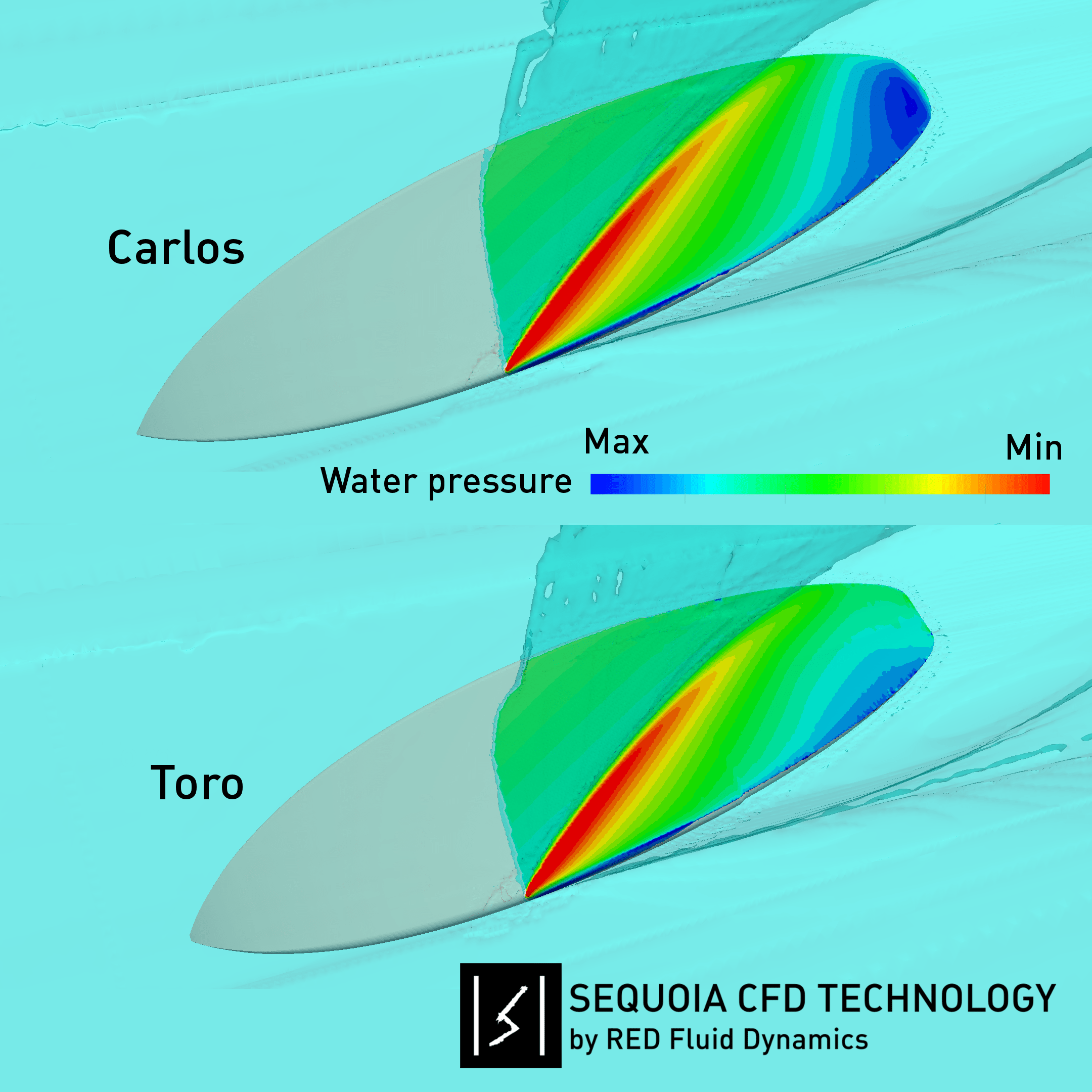
Here is another look at Carlos and Toro models in planing/take off conditions from the CFD simulations performed by @redfluiddynamics, where the pressure maps and the hydrodynamic forces on the boards are shown in the pictures. If you look at the pressure maps, you will notice how the Carlos has less pressure in the tail, with the minimum located towards the end of the board and close to the central fin, whereas the Toro features higher pressure and the minimum pushed forward in between the front fins. This gives the Carlos high responsiveness in powerful surf and great lift and stability to the Toro in medium size waves. For example, during a radical take off the low pressure right under your back foot in the Carlos will help you to hold on the face of the wave and then initiate your turn.

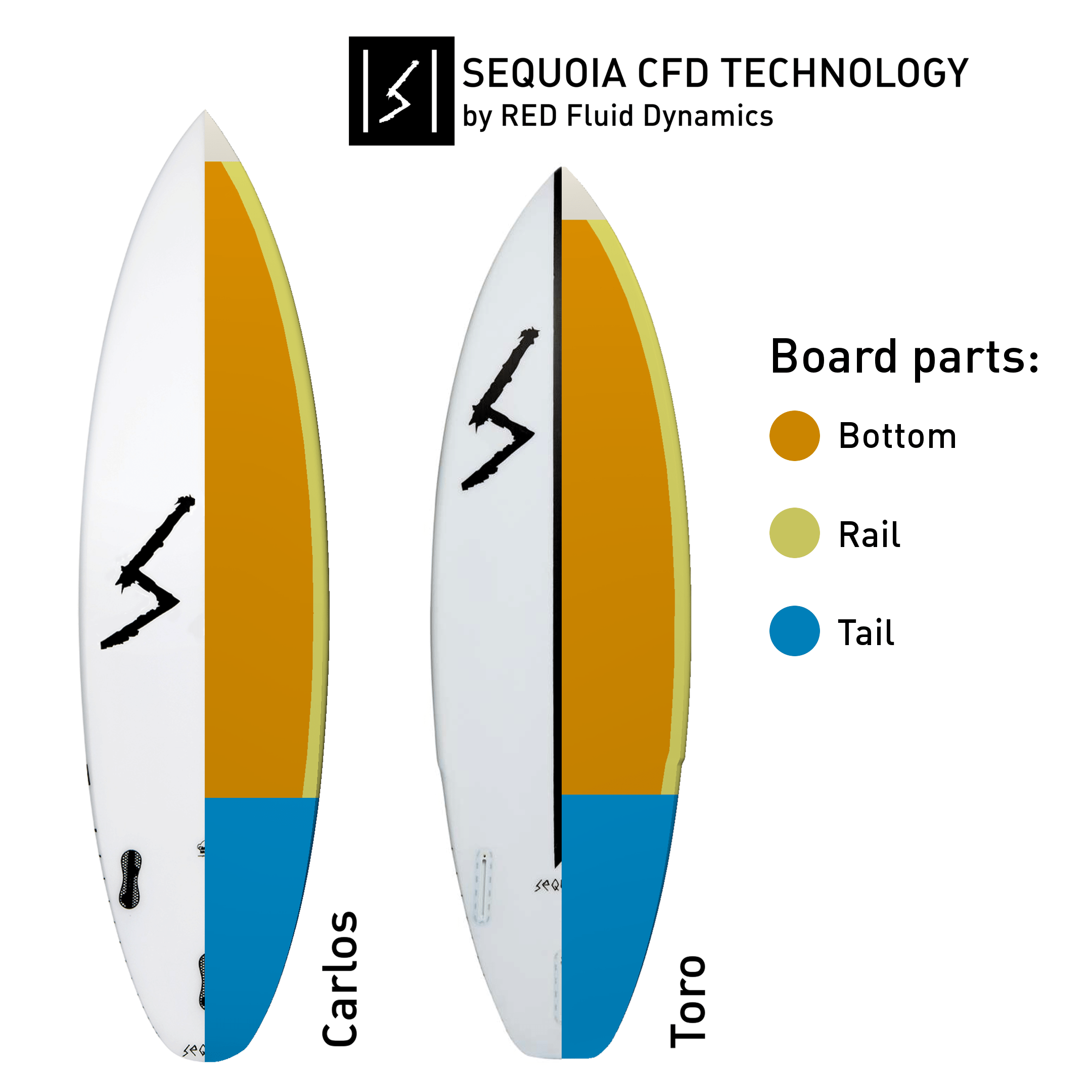
On the other hand, looking at the histrograms showing the hydrodynamic forces, you can see how the Toro is able to produce lot of lift even with minimum increase in drag. The analysis of drag and lift contributions to the board given by the main components of the design (bottom, tail and rail shape) and made possible by the CFD technology, also show how such increase in efficiency in the Toro is obtained by compensating the increase in drag coming from the bottom of the board with reduced drag coming from the tail thanks to the optimal exit rocker.


THE CARVE
the carving simulations are performed to analyze the water flow interaction with the boards after take off and alongside planing simulations to get a comprehensive view of the boards performance in different conditions. In the simulations performed by @redfluiddynamics and shown here, the Carlos and Toro models are analzyed right at the peak of a bottom turn. The comparison of the pressure maps on the boards (first picture) reveals the effect of the rocker curve and of the concaves and the differences with the planing conditions. In the Carlos, featuring a single deeper concave than Toro, an extended area of high pressure (red in the picture can be seen where the water impacts with the board along with lower pressure in the tail (blue in the picture).

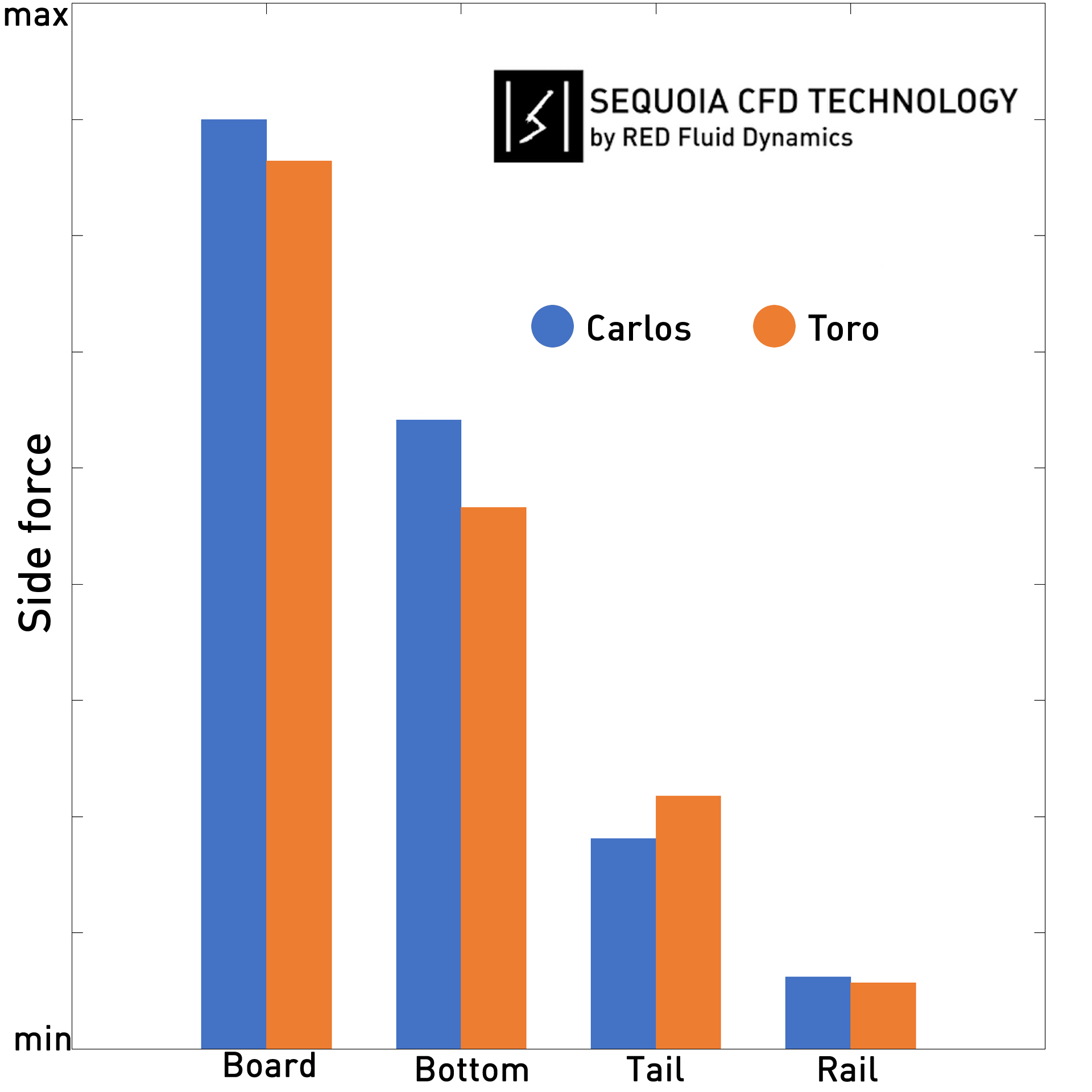
The histograms of hydrodynamic forces show how this gives greater hold overall (side force) to the Carlos, helping to push through strong bottom turns. The analysis of the different design components, also show how such an increase in side force is mostly located under your front foot (bottom component) with a touch in the rail, whereas the lower pressure under your back foot (tail component) along with the reduced lift in the rail helps to draw your lines more easily in powerful surf. The Toro on the other hand features less drag to help keeping your speed in weaker surf along with increased stability thanks to increased balance between the front and the back foot and increased lift in the rail.


THE BOTTOM TURN
while performing a bottom turn, the surfer leans forward and towards the line he wants to draw, applying pressure on the inward side of the board and pushing the rail down. At the same time the water reacts by applying pressure on the board and contrasting the roll movement of the board.


Using the CFD technology, we are able to visualize the water pressure during the bottom turn and compute the roll moment, the reaction of the water contrasting the action of the surfer. In the pictures, the water pressure acting on the board during the same bottom turn is shown for the Carlos and Toro models by Sequoia Surfboards and the roll moment acting on the two boards compared in the graph.


From the compuations, the roll moment of the Carlos is found 20% lower than the Toro, improving the responsivness on the board in critical surf. On the other hand, the Toro provides increased stability and more control. In the same graph, the pitch and yaw moments are also compared, represening the tendency of the board to move the nose up and towards the turn, respectively, and confirming the easier transition through the turn given by the Carlos and the increased stability of the Toro (10% more than in the Carlos).